
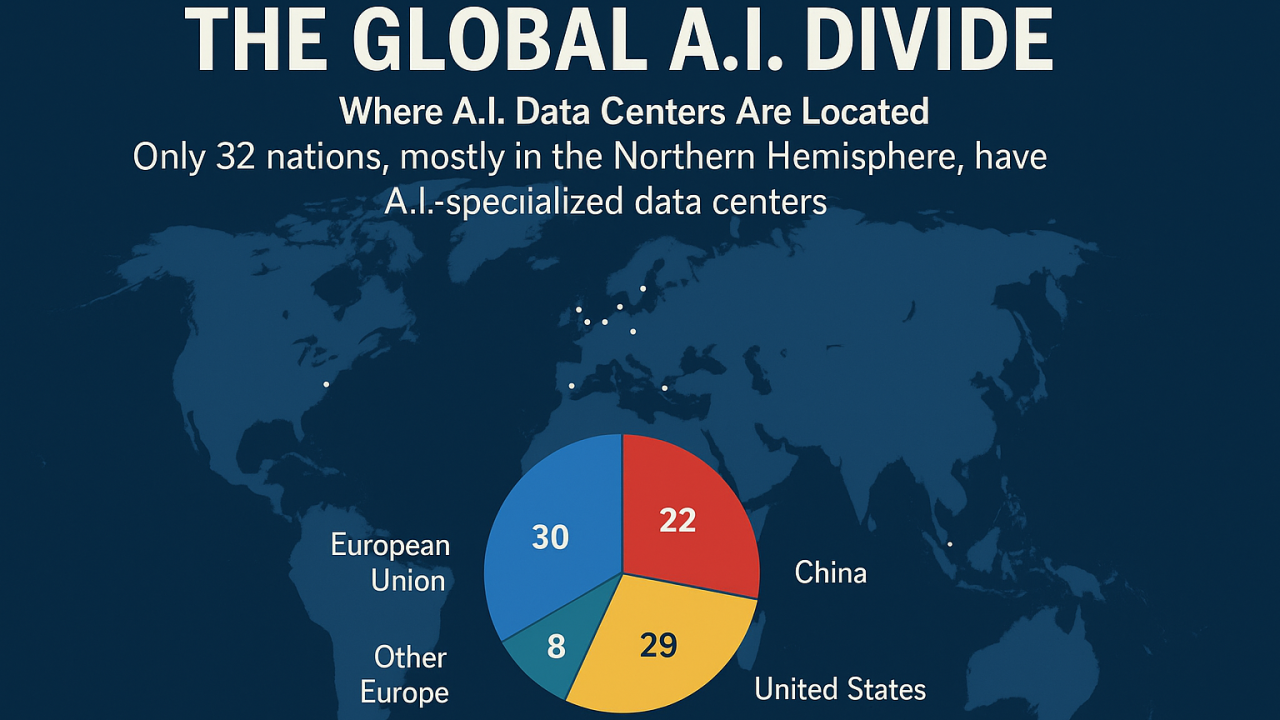

As artificial intelligence transforms everything from healthcare and scientific discovery to national security and digital sovereignty, a clear truth has emerged: the world is dividing into two groups—those with AI compute power, and those without.
💡 A New Digital Frontier
Only 32 countries, mostly in the Northern Hemisphere, currently host AI-specialized data centers—critical infrastructure for training large-scale models, supporting local innovation, and enabling scientific discovery. Over 150 countries, spanning much of Africa and South America, are completely excluded from this landscape.
“We are losing,” says Nicolás Wolovick, an Argentinian researcher operating a small-scale AI lab in a converted classroom—an echo of the struggles faced across the Global South.
The result? An AI-powered compute divide, widening disparities in research capability, economic opportunity, and cultural representation.
🇺🇸🇨🇳 Compute Superpowers—And the Rest
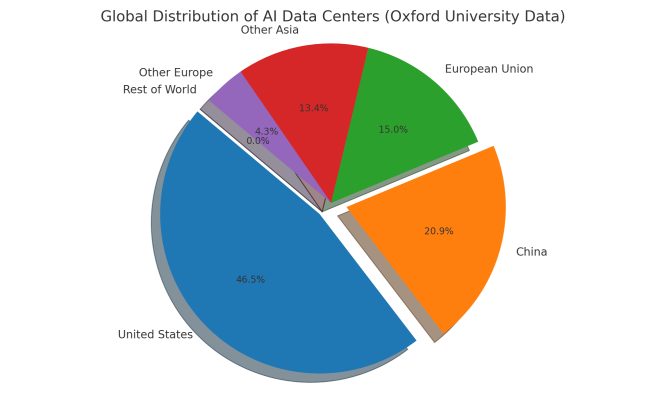
The U.S. and China dominate global AI infrastructure, controlling over 90% of AI data centers, with companies such as Microsoft, Google, Amazon, Tencent, and Alibaba leading the expansion efforts. These giants also control access to Nvidia GPUs, the gold standard for cutting-edge AI. Countries lacking local computing capabilities must rely on distant cloud services, a costly workaround that introduces latency issues, legal complexities, and data sovereignty risks.
🇸🇦 Saudi Arabia Enters the Arena
Saudi Arabia is making a bold leap into the AI computing space:
- Humain, launched in May 2025 under the Public Investment Fund and led by Crown Prince Mohammed bin Salman, aims to develop a world-class AI infrastructure and handle 7% of global AI workloads by 2030
- Massive deals totaling over $23 billion have been secured with industry leaders:
- Public-private projects include initiatives supporting local innovation ecosystems through events like LEAP and DeepFest—Saudi-funded forums that highlight AI talent, policy, and future trends.
These efforts mark a significant shift: Saudi Arabia is moving from a consumer to a creator of AI infrastructure, emphasizing compute sovereignty and global competitiveness.
📉 What’s at Stake
Without compute parity, countries face many risks:
- Innovation bottlenecks: No compute → limited research and development capacity.
- Startup constraints: Local ventures hindered by infrastructure gaps.
- Brain drain: Talent moves to compute-rich regions.
- Model bias: AI models trained mainly on dominant languages and contexts overlook global perspectives.
- Geopolitical vulnerability: Compute-dependent nations are vulnerable to foreign tech control.
Saudi Arabia’s strategy—massive investment, green energy integration, and multi-partner contracts—could serve as a model for other emerging economies aiming for AI parity.
🚨 The Call to Action
Bridging the compute gap requires bold, coordinated efforts:
- International coalitions to support computer deployment in underserved areas.
- Partnerships between governments, sovereign wealth funds, and hyperscalers.
- Talent pipelines through AI-focused education, training, and events.
- Sovereign compute laws to establish data embassies and legal protections.
- Green compute hubs powered by renewable energy, exemplified by Saudi’s NEOM and Oxagon projects.
AI leadership must be shared—it cannot be siloed. The rise of Saudi Arabia’s compute infrastructure via Humain marks a turning point. For AI to stay a global, inclusive movement, nations must invest in infrastructure, partnerships, and policies to distribute compute power fairly.
Let’s support a future where compute power is a right, not a privilege—and where innovation thrives everywhere. 🌍🚀