About Me
Lorem ipsum dolor sit amet, consectetur adipisicing elit. Eum in eos saepe ipsa cupiditate accusantium voluptatibus quidem nam, reprehenderit, et necessitatibus adipisci labore sit veritatis vero tempore sequi at sed facere dolore. Quae obcaecati eius quasi doloribus illum minus fugit.
Lorem ipsum dolor sit amet, consectetur adipisicing elit. Eum in eos saepe ipsa cupiditate accusantium voluptatibus quidem nam, reprehenderit,
What I Do
Business Stratagy
I throw myself down among the tall grass by the stream as Ilie close to the earth.
Business Stratagy
I throw myself down among the tall grass by the stream as Ilie close to the earth.
My Best Work
The services provice for Android user
Lorem ipsum dolor sit amet consectetur adipisicing elit. Modi, quidem dignissimos. Perspiciatis fuga soluta officiis eligendi labore, omnis ut velit vitae suscipit alias cumque temporibus.
Responsive design
Quiz builder
Certification
Stats & reports
Retina ready
The services provice for Development
Lorem ipsum dolor sit amet consectetur adipisicing elit. Modi, quidem dignissimos. Perspiciatis fuga soluta officiis eligendi labore, omnis ut velit vitae suscipit alias cumque temporibus.
Responsive design
Quiz builder
Certification
Stats & reports
Retina ready
The services provice for Android user
Lorem ipsum dolor sit amet consectetur adipisicing elit. Modi, quidem dignissimos. Perspiciatis fuga soluta officiis eligendi labore, omnis ut velit vitae suscipit alias cumque temporibus.
Responsive design
Quiz builder
Certification
Stats & reports
Retina ready
Our Trusted Client
Testimonial
Amy Smith Engineer
@mr_rasel Ypur plaser well for your template from @mr_faruk There is no is best issueusing it too. It'll really speed up the design and development process :).
Amy Smith Engineer
@mr_rasel Ypur plaser well for your template from @mr_faruk There is no is best issueusing it too. It'll really speed up the design and development process :).
Amy Smith Engineer
@mr_rasel Ypur plaser well for your template from @mr_faruk There is no is best issueusing it too. It'll really speed up the design and development process :).
Amy Smith Engineer
@mr_rasel Ypur plaser well for your template from @mr_faruk There is no is best issueusing it too. It'll really speed up the design and development process :).
Our Pricing
Use the free templates with your whole team or choose a premium. ith your whole team or choose a premium.
Get the bundle and get lifetime support and one year updates.
STARTER
Try and decide.$0
BUNDLE
Try and decide.$60
My Blog
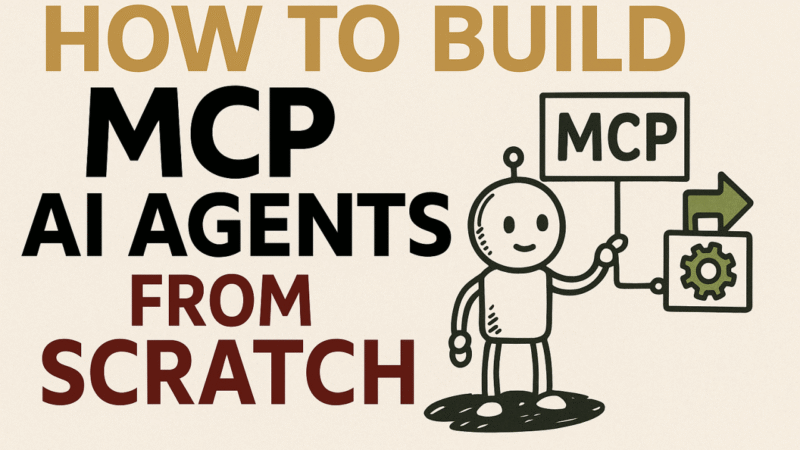
How to Build MCP AI Agents from Scratch
Building MCP AI Agents from Scratch: A 9-Step Guide
Imagine your team wants an AI assistant that can pull data from documents, interact with your apps, and automate tasks – all without custom-coding every integration. The Model Context Protocol (MCP) offers a way to make this happen. MCP is an open standard that lets AI agents plug into tools and data sources like a universal adaptor. Think of MCP like a USB-C port for AI applications – it provides a standardized way to connect AI models to different data and tools. In this article, we’ll walk through 9 steps to build an MCP-powered AI agent from scratch, blending a real-world narrative with technical how-to. Whether you’re a developer or a product manager, you’ll see how to go from a bright idea to a working AI agent that can actually do things in the real world.
In short: MCP replaces one-off hacks with a unified, real-time protocol built for autonomous agents. This means instead of writing custom code for each tool, your AI agent can use a single protocol to access many resources and services on demand. Let’s dive into the step-by-step journey.
Step 1: Define the Agent’s Goals and Scope
Every successful project starts with a clear goal definition. In this step, gather your technical and business stakeholders to answer: What do we want the AI agent to do? Be specific about the use cases and the value. For example, imagine Lucy, a product manager, and Ray, a developer, want an AI assistant to help with daily operations. They list goals like:
- Answer team questions from internal documents. (e.g. search knowledge bases and summarize answers)
- Automate simple tasks. (e.g. schedule meetings, create draft emails or reports)
- Interact with external services. (e.g. fetch data from a CRM or update a spreadsheet)
Defining the scope helps align expectations. A focused agent (say, an “AI Project Assistant”) is easier to build than a do-everything agent. At this stage, involve business stakeholders to prioritize capabilities that offer real ROI. Keep the scope realistic for a first version; you can always expand later.
Deliverable: Write a short Agent Charter that outlines the agent’s purpose, users, and key tasks. This will guide all subsequent steps.
Step 2: Plan the Agent’s Capabilities and Tools
With goals in mind, identify what capabilities the agent needs and which tools or data sources will provide them. In MCP terms, these external connections will be MCP servers offering tools and resources to the AI agent. Make a list of required integrations, for example:
- Internal knowledge – e.g., a company knowledge base or documents. (This might require a vector database for retrieval, which we’ll cover soon.)
- Productivity tools – e.g., a calendar API for scheduling or an email service for sending notifications.
- Enterprise data – e.g., a database or CRM to fetch stats or updates.
For each needed function, decide if an existing service or API can fulfill it, or if you’ll build a custom tool. MCP is all about standardizing these connections: you might find pre-built MCP servers for common services (file systems, GitHub, Slack, databases, etc.), or you may implement custom ones. The good news is that as MCP gains adoption, a marketplace of ready connectors is emerging (for example, directories like mcpmarket.com host plug-and-play MCP servers for many apps). Reusing an existing connector can save time.
Tool Design Tip: Don’t overload your agent with too many granular tools. MCP best practices suggest offering a few well-designed tools optimized for your agent’s specific goals. For instance, instead of separate tools for “search document by title” and “search by content”, one search_documents tool with flexible parameters might suffice. Aim for tools that are intuitive for the AI to use based on their description.
By the end of this planning step, you should have a clear mapping of capabilities → tools/data. For our example, Lucy and Ray decide the agent needs:
- A Document Search tool to query internal docs (likely using a vector database for semantic search).
- A Scheduler tool to create calendar events.
- An Emailer tool to send summary emails.
- A connection to the Company Database as a resource for the latest metrics.
This planning sets the stage for development. Now it’s time to prepare the data and context that the agent will use.
Step 3: Prepare the Knowledge Base with a Vector Database
One key capability in many AI agents is retrieving relevant information on the fly. This is often achieved through Retrieval-Augmented Generation (RAG), where the agent fetches reference data (e.g. documents, knowledge base entries) to ground its answers. Here, vector databases and embeddings come into play.
Embeddings are numerical representations of text (or other data) that capture semantic meaning. Essentially, an embedding model turns a piece of text into a list of numbers (a vector) such that similar texts map to nearby vectors in a high-dimensional space. In practical terms, if two documents talk about similar topics, their embeddings will be mathematically close, enabling the AI to find relevant content by semantic similarity. For example, an embedding model encodes data into vectors that capture the data’s meaning and context, so we can find similar items by finding neighboring vectors.
A vector database stores these embeddings and provides fast search by vector similarity. You can imagine it as a specialized search engine: you input an embedding (e.g. for a user’s query) and it returns the most similar stored embeddings (e.g. paragraphs from documents), often using techniques like nearest-neighbor search. This allows the agent to pull in relevant snippets of information beyond what’s in its prompt or training data, greatly enhancing its knowledge.
For our project, Ray sets up a small pipeline to ingest the company’s internal documents into a vector DB:
- Choose an embedding model – e.g. OpenAI’s text-embedding-ada-002 or a local model. Each document (or chunk of text) will be converted into a vector.
- Generate embeddings and store in the vector database. Each entry links the vector to the source text (and maybe metadata like title or tags).
- Test the retrieval – Given a sample query, ensure the vector DB returns relevant snippets.
Here’s a pseudocode example of how this might look:
# Pseudocode: Prepare vector database
documents = load_all_internal_docs() # your data source
embeddings = [embedding_model.embed(doc.text) for doc in documents]
vector_db.store(items=documents, vectors=embeddings)
# Later, for a query:
query = "What were last quarter's sales in region X?"
q_vector = embedding_model.embed(query)
results = vector_db.find_similar(q_vector, top_k=3)
for res in results:
print(res.text_snippet) # relevant content the agent can use in its answer
Now the agent has a knowledge resource: it can query this vector DB to get facts and figures when needed. In MCP terms, this vector database will likely be exposed as a resource or a tool on an MCP server (more on that in a moment). In fact, using MCP for retrieval is a powerful pattern: MCP can connect to a vector database through a server action, letting an agent perform a semantic search on demand. This means our agent doesn’t need all knowledge upfront in its prompt – it can call a “search” tool to query the vector DB whenever the user asks a question requiring external info.
Before coding the agent, Lucy ensures that the business side (e.g. privacy, compliance) is okay with storing and accessing this data. With green light given, the vector store is ready and filled with up-to-date knowledge for the AI to draw upon.
Step 4: Set Up the MCP Framework (Environment & Architecture)
Now it’s time to get hands-on with MCP (Model Context Protocol) itself. At its core, MCP has a client-server architecture. The AI agent (host) uses an MCP client to communicate with one or more MCP servers. Each MCP server provides a set of tools, resources, or prompts that the agent can use.
In our scenario:
- The agent app (which we’ll build in a later step) will act as the MCP Host with an integrated MCP client.
- We will create or configure MCP servers for the functionalities we planned (document search, scheduling, etc.). These servers can run locally or remotely.
First, decide on the development stack and environment:
- Choose an MCP implementation: MCP is an open protocol with SDKs available in multiple languages. For example, there are reference implementations in Python, TypeScript, etc., as well as cloud-specific offerings (Cloudflare’s platform for MCP, Azure’s MCP support in Container Apps, etc.). Ray might opt for a language he’s comfortable with – say, Python for the agent logic and maybe TypeScript or Python for the MCP servers.
- Install necessary tools: This could include installing the MCP SDK or CLI, and the MCP Inspector (a developer tool we’ll use for testing). The MCP Inspector is a handy interactive tool (running via Node.js npx) that helps you run and debug MCP servers.
- Decide on local vs remote: In development, local MCP servers (using stdio transport) are easiest: the server runs as a subprocess on your machine and communicates via standard input/output. For production or sharing with others, you might deploy remote MCP servers that communicate over HTTP (Server-Sent Events). Initially, Lucy and Ray run everything locally for rapid iteration, with plans to containerize and deploy servers to the cloud later for scaling.
MCP’s architecture is straightforward once you see it: the agent doesn’t call tool APIs directly; instead, it sends a structured request to an MCP server which then translates it to the actual action (be it a database query or API call) This decoupling means the agent doesn’t need to know the low-level details – it just knows the name of the tool and what it’s for. The server advertises these capabilities so the agent can discover them. MCP ensures all communication follows a consistent JSON-based schema, so even if the agent connects to a new tool it’s never seen, it can understand how to use it.
Key Concepts:
- Tools in MCP: Typically actions that can change state or have side effects. For example, “send_email”, “create_event”, “update_record”. Tools take inputs and produce outputs (or perform an action).
- Resources in MCP: Usually read-only data sources or information retrieval endpoints. They return data but don’t perform an external action. Our vector DB search might be modeled as a resource (since it fetches info) or as a tool – the line can blur, but conceptually it’s just getting data.
- Prompts: Reusable prompt templates or workflows the server can provide, which can help standardize how the AI and server communicate for certain tasks. We won’t deep-dive into prompts here, but know that MCP can also manage prompt templates if needed.
With environment set up, Lucy and Ray have the MCP groundwork ready. Next, they’ll create the specific tools and resources on the MCP servers to fulfill the agent’s needs.
Step 5: Implement and Register MCP Tools & Resources
This is the core development step: building the MCP server(s) that expose the functionalities we planned. If you found a pre-built MCP server for some tool (e.g. an existing “calendar” server or “filesystem” server), you can simply run or adapt it. But here, we’ll assume you’re making custom integrations from scratch to see how it’s done.
a. Creating an MCP Server: An MCP server is essentially an application (could be a simple script or web service) that defines a set of actions (tools/resources) and handles requests for them. For instance, to implement our Document Search capability, Ray creates a server (let’s call it “KnowledgeServer”) with a tool or resource named search_docs. The server code will roughly:
- Initialize an MCP server object (giving it a name, version, etc.).
- Define the schema and logic for each tool/resource:
- For search_docs, define that it accepts a query string and maybe a number of results, and returns text results.
- The logic will take the input, call the vector database (from Step 3), and return the top matches.
- Do similarly for other tools: e.g., a schedule_meeting tool (calls calendar API), and an send_email tool (calls email API). These might be separate servers or combined, depending on design. Often, one MCP server might group related tools (e.g. a “ProductivityServer” for calendar/email).
- Include descriptions for each tool and its parameters. This is critical: the AI agent relies on these descriptions to decide when and how to use a tool. A good description might be: Tool name: schedule_meeting – Description: “Creates a calendar event. Input: title (string), date_time (datetime), participants (list). Output: confirmation message.” Clear descriptions help the AI use tools correctly.
b. Tool Registration: Once the server logic is ready, you “register” the tools so that an MCP client can discover them. In practice, if using an MCP SDK, this might mean adding the tool definitions to the server object. Many MCP frameworks will automatically share the tool list when the agent connects (this is known as capability discovery). For example, the server might implement a method to list its tools; when the agent connects, it fetches this list so the AI knows what’s available. In code, this can be as simple as adding each tool to the server with its handler function. If you’re writing servers in Node or Python, you might use an SDK function to register a tool, providing its name, input schema, and a function callback to execute.
c. Handling Resources: If some data is better exposed as a read-only resource (for instance, a static database or a subscription feed), MCP supports that too. In our case, we could treat the vector DB as a resource. The server would expose it such that the agent can query or subscribe to updates. The difference is mostly semantic – tools vs resources – but resources might be listed separately in something like the MCP Inspector interface (which has a Resources tab).
d. Security and permissions: At this point, consider what each tool is allowed to do. MCP servers often run with certain credentials (API keys, database access) and you might not want to expose every function to the agent. Implement permission checks or scopes if needed. For example, ensure send_email can only email internal domains, or the search_docs can only access non-confidential docs. MCP encourages scoped, narrowly-permissioned servers to avoid over-privileged agents.
By the end of Step 5, you have one or more MCP servers implemented with the necessary tools/resources. They’re essentially adapters: converting the AI’s requests into real actions and then returning results. For instance, our KnowledgeServer takes an AI query like “Find Q3 sales for Product A” and translates it into a database lookup or vector DB search, then gives the answer back to the AI.
Before unleashing the whole agent, it’s wise to test these servers in isolation. This is where the next step – using the MCP Inspector – becomes invaluable.
Step 6: Test and Debug with MCP Inspector
Even the best plan needs testing. The MCP Inspector is a developer tool that provides an interactive UI to load your MCP server and poke at it to ensure everything works correctly. Think of it as a combination of API tester and live debugger for MCP.
Ray fires up the MCP Inspector for the KnowledgeServer:
- Using a simple command like npx @modelcontextprotocol/inspector npx @your-org/knowledge-server, the inspector launches the server and connects to it.
- The Inspector window shows all the declared Tools, Resources, and Prompts the server provides. For example, under the Tools tab, Ray sees search_docs listed with its input schema and description. This confirms the tool registration worked.
- He can manually invoke search_docs by providing a test query in the Inspector. Upon running it, the Notifications pane shows logs and any output or errors. Suppose the first run returns an error because of a typo in the database query – he can catch that now and fix the server code.
- The Resources tab similarly shows any resources. If the vector DB was set as a resource, Ray can inspect its metadata and test querying it directly.
- The Inspector also ensures capability negotiation is happening: essentially, the server advertises what it can do, and the client (Inspector acting as a client) acknowledges it. If something isn’t showing up, that’s a sign the server’s tool definitions might be misconfigured.
Using the Inspector, Lucy and Ray iteratively refine the servers:
- They add better error handling (the Inspector logs help identify edge cases, like what if search_docs gets an empty query).
- They test unusual inputs (like scheduling a meeting in the past) to ensure the server responds gracefully – a process akin to writing unit tests for each tool.
- They ensure performance is acceptable (the Inspector can’t do full load testing, but they might simulate a few rapid calls).
By the end of testing, the MCP servers are robust and ready. Importantly, this step gave the confidence that each piece works in isolation. It’s much easier to troubleshoot issues here than when the AI is in the loop, because you can directly see what the server is doing. As a best practice, treat the Inspector as your friend during development – it significantly speeds up debugging of MCP integrations.
Step 7: Integrate the AI Model and Configure the Agent App
Now for the fun part: bringing the AI brain into the picture and configuring the agent application. At this stage, we have:
- Functional MCP servers (for docs, calendar, email, etc.).
- A knowledge base (vector DB) the agent can query via those servers.
- Clear tool definitions and descriptions.
What we need now is the actual AI agent logic that will use a Large Language Model (LLM) to interpret user requests, decide which tools to call, and compose responses. This typically involves using an AI model (like GPT-4, Claude, etc.) and an agent orchestration framework or prompt strategy (for example, a ReAct prompt that allows the model to reason and choose tools).
a. Building the Agent’s Brain: The agent is essentially an LLM with an added ability to use tools. Many frameworks (LangChain, OpenAI function calling, etc.) exist for this, but MCP can work with any as long as you connect the MCP client properly. If using the OpenAI Agents SDK (hypothetically), one might configure an Agent and pass in the MCP servers as resources. In code, it could look like:
llm = load_your_llm_model() # e.g. an API wrapper for GPT-4
agent = Agent(
llm=llm,
tools=[], # could also include non-MCP tools if any
mcp_servers=[knowledge_server, productivity_server] # attach our MCP servers
)
When this agent runs, it will automatically call list_tools() on each attached MCP server to learn what tools are available. So the agent might get a list like: [search_docs, schedule_meeting, send_email] with their descriptions. The agent’s prompt (which you craft) should instruct it to use these tools when appropriate. For example, you might use a prompt that says: “You are a helpful assistant with access to the following tools: [tool list]. When needed, you can use them in the format: ToolName(inputs).” Modern LLMs can follow such instructions and output a structured call (like JSON or a special format) indicating the tool use.
b. Agent App Configuration: Beyond the LLM and tool hookup, consider the app environment:
- Interface: How will users interact? Maybe a chat UI where they ask questions and the agent answers. Lucy ensures the front-end (if any) is ready to display agent responses and maybe even intermediate steps (for transparency).
- Model parameters: Set things like temperature (to control creativity), max tokens, etc., appropriate for your use case. A business report summary might need a low-temperature (factual), whereas brainstorming ideas might allow more creativity.
- System prompts or guardrails: Provide any necessary context or rules to the AI. For instance, a system prompt might state: “You are an AI assistant for ACME Corp. You have access to company data via tools. Answer concisely and factually, and use tools for any data you don’t know.”
- MCP Client setup: If not using a high-level SDK, you might need to explicitly initialize an MCP client and connect to the servers. For example, in Python you might start a subprocess for the local server (as shown in Step 4 with stdio transport), or connect to a remote server via a URL. Ensure the client is authorized if needed (some servers might require an auth token or OAuth – as would be the case if connecting to something like an Azure-hosted server with protected resources).
- Tool invocation logic: Depending on your approach, the agent might automatically decide when to call tools (typical in frameworks using ReAct or function calling). Alternatively, you might implement a simple loop: the LLM’s output is checked – if it indicates a tool use, call the MCP client’s execute function for that tool, get result, feed it back to LLM – and continue until the LLM produces a final answer. This is essentially how an autonomous agent loop works.
c. Testing the Integrated Agent: Before deploying, try some end-to-end queries in a controlled setting. For example:
- Ask the agent: “What were last quarter’s sales in region X?” It should decide to use search_docs (or perhaps a query_db tool) to retrieve that info, then compile an answer.
- Tell the agent: “Schedule a meeting with Bob tomorrow at 3pm.” It should use schedule_meeting, get a confirmation, and maybe respond with “Meeting scheduled.”
- A multi-step request: “Find the top customer complaints from last month and draft an email to the team with a summary.” This might require two tool uses – one to search complaint logs (documents) and another to send an email. See if the agent can handle using multiple tools sequentially. MCP allows chaining tools – thanks to the structured protocol, the agent can call one tool, get data, then decide to call another, all within one conversation.
If any of these fail, you may need to refine the prompt or provide more examples to the model on how to use the tools (few-shot examples in the system prompt can help). This is a bit of an art – effectively prompt engineering and agent coaching. But once it’s working, you truly have an AI agent that’s context-aware, meaning it can fetch real data and take actions, not just chat generically.
Lucy and Ray can now see their creation in action: the AI assistant responds to questions with actual data from their knowledge base, and can perform tasks like scheduling meetings. The gap between AI and real-world action is being bridged by MCP.
Step 8: Deploy the Agent Application
Having a prototype running on a developer’s machine is great, but to be useful, it needs to be accessible to users (which could be internal team members or external customers). Deployment involves making both the agent application and the MCP servers available in a reliable, scalable way.
Key considerations for deployment:
- MCP Server hosting: Decide where your MCP servers will live. Options include cloud platforms (for example, deploying as microservices on Azure, AWS, Cloudflare, etc.) or on-premises if data can’t leave your network. The servers are just apps, so you can containerize them (Docker) and deploy to a container service. Azure provides templates for MCP servers on Container Apps. Cloudflare lets you host MCP servers on their edge network – or you simply run them on a VM or Kubernetes cluster. Ensure that each server has the necessary environment (e.g. API keys for calendar/email, access to the vector DB, etc.). Also set up monitoring and logging for these servers to catch any runtime errors.
- Scaling the servers: If you expect high load, you might run multiple instances behind a load balancer. MCP uses stateless request-response for tools (and SSE streams for events), which scales fairly well horizontally. One of the advantages of MCP’s standardized interface is that clients can connect to remote servers easily – so you could even have one central knowledge server that many agents (clients) connect to.
- Agent app integration: If the agent is part of a larger application (say, integrated into a web dashboard or a Slack bot), deploy that application accordingly. For example, if it’s a Slack bot, you’d deploy the bot service and ensure it can initiate the agent logic when a message comes in.
- Security: Now that it’s live, secure the connections. Use encryption (HTTPS) for remote MCP connections. If using OAuth or API keys for tools, ensure they’re stored safely. MCP supports authorization flows (like OAuth) to ensure only allowed clients access certain servers. For instance, you might require the agent to authenticate when connecting to the company’s knowledge server, so only approved agents can use it.
- User Access and UX: Roll out to users in stages. Lucy might pilot the agent with her team first. Provide a simple user guide explaining what the agent can do (“Try asking it to fetch data or automate a task”). At the same time, gather feedback. Users might discover new desired features or confusing behaviors which you can iterate on.
During deployment, also consider failure modes. What if a tool fails (e.g., email API down) – does the agent handle it gracefully (perhaps apologizing to user and logging the error)? It’s wise to implement fallback responses or at least error messages that make sense to the end-user, rather than exposing technical details. MCP servers typically handle errors by returning structured error responses that the client (agent) can interpret, so make sure to propagate those to the user in a friendly way.
With everything deployed, your AI agent is now in the wild, working across the systems you connected. It’s time to look at the bigger picture and future expansion.
Step 9: Scale and Expand Across Applications
The final step is an ongoing one: scaling and evolving your MCP-based AI agent across the organization and to new use cases. This is where the true payoff of MCP’s standardized approach becomes evident.
Here are ways to scale and expand:
- Increase Usage Scale: As more users start using the agent, monitor the load on the MCP servers and the LLM API. Scaling might mean upping the compute for the vector database, adding more worker processes for the MCP servers, or using a more powerful LLM model for faster responses. Cloud providers can help scale these components (for example, using Azure’s managed services for the vector DB or auto-scaling container instances for MCP servers).
- Add More Tools: Once the initial agent proves its value, stakeholders will likely want new features. Thanks to MCP, adding a feature often means spinning up another MCP server (or extending an existing one) with the new tool, rather than altering the core agent logic. For example, if the Sales department now wants the agent to also update CRM records, you can build a “CRM Server” with a update_crm tool, and then register that with the agent. The standardized protocol means the agent can incorporate it without a heavy rework – it’s like plugging a new peripheral into your USB-C port.
- Cross-Domain and Multiple Apps: MCP fosters a tool ecosystem that can be reused by different AI agents and applications. Suppose another team develops a customer support chatbot. It could connect to the same KnowledgeServer to retrieve answers, and maybe you give it access to a “FAQ database” resource. In other words, you can have multiple AI agents (with different personas or purposes) all tapping into a common pool of MCP servers. This avoids siloed development – build a tool once, use it in many AI apps.
- Organization-wide Context: Over time, you might accumulate a suite of MCP servers covering various internal systems (documents, code repository, inventory DB, etc.). MCP is designed to maintain context as AI moves between tools – meaning an agent can carry what it learned from one query into the next tool call. This helps in multi-step workflows. Scaling across apps also means maintaining a level of consistency: define conventions for tool names, ensure all servers follow security guidelines, and possibly develop an internal MCP marketplace for your company where devs can discover and contribute connectors (mirroring the public MCP marketplaces that are emerging).
- Monitoring and Improvement: At scale, keep an eye on how the agent is used. Analyze logs: which tools are called most, what questions are asked, where does the agent fail or hallucinate? This data is gold for improving both the AI’s prompt and the underlying tools. You might add more knowledge to the vector DB if you see unanswered questions, or improve a tool’s reliability if errors occur. Continuously refine the agent’s abilities and maybe integrate newer LLMs as they become available for better performance.
Scaling is not just about tech; it’s about organizational adoption. Lucy can champion how the AI agent saves everyone time, turning skeptics into supporters. With robust MCP-based infrastructure, the team can confidently say yes to new feature requests because the modular architecture handles growth gracefully. Instead of a monolithic AI system that’s hard to change, you have a Lego set of AI tools – adding a new piece is straightforward without breaking others.
Conclusion: From Idea to Reality with MCP
In this journey, we saw how a team can go from a simple idea – “let’s have an AI assistant that actually does things” – to a working agent powered by the Model Context Protocol. We followed a 9-step framework: from clearly defining goals and planning capabilities, through building the data foundation with vector embeddings, setting up the MCP environment, implementing and registering tools/resources, testing with the MCP Inspector, wiring up the AI model, and finally deploying and scaling the solution. Throughout, we used a narrative example to make it tangible how each step might look in practice.
The result is an AI agent that is more than just a chatty assistant – it’s action-oriented and context-aware. By leveraging MCP’s open standard, our agent can seamlessly connect to various services and data sources in real time, which is a big leap from traditional isolated AI models. Instead of custom code for every integration, MCP gave us a plug-and-play architecture where the focus was on what the agent should do, not how to wire it all up.
For developers, MCP offers a flexible framework to build complex workflows on top of LLMs, while ensuring compatibility and structured interactions. For business stakeholders, it means AI solutions that can actually operate with live data and systems, accelerating automation and insights. It’s a win-win: faster development and more capable AI agents.
As you consider adopting MCP for your own projects, remember that it’s an open protocol and community-driven effort. There’s a growing ecosystem of tools, SDKs, and pre-built connectors that you can tap into. The story of Lucy and Ray’s agent is just one example – across industries from finance to marketing to operations, the approach is similar. Define the goal, assemble the pieces with MCP, and let your AI agents loose on real-world tasks.
In summary, building an MCP AI agent from scratch may involve many moving parts, but each step is manageable and logical. And the end product is incredibly powerful: an AI that not only understands language, but can take action using the full context of your organization’s knowledge and tools. It’s a glimpse into the future of AI in the enterprise – a future where AI agents are as integrated into our software stack as any microservice or API. Given the momentum behind MCP (with companies like Anthropic, Microsoft, and others championing it), now is a great time to start building with this new “USB-C for AI.” Your team’s next big AI idea might be closer to reality than you think.
What use case would you build first if you had your own MCP-powered AI agent?
Do you believe MCP will become the standard interface layer for enterprise AI agents — or is there another protocol you’re betting on?

What is HUMAIN? Inside Saudi Arabia’s Ambitious New AI Powerhouse
In the past few days, everyone is talking about HUMAIN Colleagues, friends – even non-tech folks – keep asking me “What exactly is HUMAIN?” As an AI professional in Saudi Arabia, I’ve decided to write this in-depth article to explain what HUMAIN is all about. My goal is to make it easy for everyone – from students and CEOs to investors and the general public – to understand this trending initiative that has filled us with excitement and national pride.
Crown Prince Mohammed bin Salman launched HUMAIN in May 2025 as a Public Investment Fund (PIF) company, aiming to position Saudi Arabia as a global AI leader.
A Visionary AI Initiative Under Saudi Vision 2030
HUMAIN is not just another tech startup – it’s a nation-scale AI initiative. Officially launched on May 12, 2025, by Crown Prince Mohammed bin Salman, HUMAIN is a PIF-owned artificial intelligence company with a bold mandate: to drive the Kingdom’s AI strategy and make Saudi Arabia a global hub for AI innovation. This aligns squarely with Vision 2030, Saudi Arabia’s blueprint to diversify the economy beyond oil through technology and innovation.
The launch of HUMAIN was high-profile and symbolic. It was announced during a Saudi-U.S. investment forum in Riyadh, attended by the U.S. President and top tech leaders like Elon Musk, Sam Altman ( OpenAI CEO), Andy Jassy ( Amazon CEO), Jensen Huang ( NVIDIA CEO), and others. In other words, the world was watching as Saudi Arabia declared its AI ambitions. The Kingdom has already been recognized for its commitment – the Global AI Index 2024 ranked Saudi Arabia first in the world for government AI strategy. HUMAIN is the flagship to implement that strategy, “empowering humanity through AI” and placing Saudi at the forefront of the AI race.
This is a source of national pride. It’s inspiring to see Saudi Arabia move from consuming technology to creating it. We’re talking about a country that’s rapidly transforming – and HUMAIN embodies that transformation in the AI domain.
End-to-End AI: What Does HUMAIN Do?
So, what exactly does HUMAIN do? In short: pretty much everything in AI. HUMAIN is designed as a full end-to-end AI value-chain provider, meaning it operates across all layers of AI development – from the core infrastructure up to user-facing applications. According to the official announcements, HUMAIN will provide a “comprehensive range of AI services, products and tools, including next-generation data centers, AI infrastructure and cloud capabilities, and advanced AI models and solutions.” One marquee goal is developing one of the world’s most powerful multimodal Arabic large language models (LLMs)– more on that later.
In practical terms, HUMAIN’s scope covers four key areas:
- Next-Generation Data Centers: Building cutting-edge data centers to power AI computations at massive scale.
- AI Infrastructure & Cloud Platforms: Providing cloud computing power and AI platforms (think of a local equivalent to AWS for AI ) so that developers and organizations can build on top.
- Advanced AI Models: Developing AI models, including large language models (LLMs) and other AI algorithms, with a special focus on Arabic and multimodal capabilities.
- AI Solutions & Applications: Creating AI-driven solutions for various sectors (energy, healthcare, finance, education, etc.), turning those models and infrastructure into real-world applications that solve problems.
This end-to-end approach is unique and ambitious. Instead of focusing on just one niche, HUMAIN aims to be a one-stop AI powerhouse – from silicon to software, from data centers to consumer apps. It’s backed directly by the sovereign wealth fund (PIF), meaning it has the capital and strategic support to pursue long-term, big-picture projects that might be too risky for a typical private startup.
Crucially, HUMAIN is meant to serve not just Saudi Arabia, but the region and the world. The company’s mission statement says it wants to enhance human capabilities and unlock new possibilities through the digital economy. By building local capabilities in AI, Saudi Arabia isn’t just importing technology – it’s creating homegrown innovations that can be exported globally. This reflects a shift to a knowledge-based economy, creating high-tech jobs and intellectual property within the Kingdom.
Arabic AI for the World: HUMAIN’s ALLAM Model and Chat App
One of the most exciting aspects of HUMAIN – especially for those of us in the Middle East – is its focus on Arabic AI. For years, Arabic speakers (over 400 million people worldwide) and Muslims (around 2 billion people) have been underserved by generative AI tools. Most AI chatbots and content generators are geared toward English or Chinese. HUMAIN is changing that.
The company’s flagship AI model is called ALLAM 34B, a 34-billion-parameter Arabic-first large language model. It’s been described as “the world’s most advanced Arabic-first AI model, fluent in Islamic culture, values and heritage”. In August 2025, HUMAIN launched HUMAIN Chat, a next-generation conversational AI app powered by ALLAM 34B. This is a big deal: it’s the first AI chatbot built in the Arab world, for the Arab world, as a fully bilingual assistant (Arabic and English).
HUMAIN Chat is available on web, iOS, and Android, and it represents a national milestone – a sovereign AI product born in Saudi Arabia. For the first time, people can interact with an AI in their own Arabic dialects and cultural context. The app can understand Arabic queries (including voice input in multiple dialects) and respond with culturally aware answers. Its features include real-time web search (so it always has up-to-date knowledge), seamless switching between Arabic and English in one conversation, and even the ability to share conversations for collaboration. Importantly, all of this is hosted on Saudi infrastructure with full compliance to local data laws, ensuring privacy and sovereignty.
Why is this so inspiring? Because it “closes a historic gap in digital inclusion”. Now, a student in Riyadh or an entrepreneur in Jeddah can use generative AI in Arabic to brainstorm ideas, learn new concepts, or get customer service – without language being a barrier. The AI’s knowledge is not just translated; it’s grounded in our values, heritage, and history. As the HUMAIN CEO Tareq Amin put it during the launch: “We are proving that globally competitive technologies can be rooted in our own language, infrastructure, and values – built in Saudi Arabia by Saudi talent. This is not the end state, but the beginning of a journey… The potential is limitless”. That mix of technical excellence and cultural authenticity is at the heart of HUMAIN’s vision.
From a technical perspective, ALLAM 34B is a milestone in AI development. It was trained on one of the largest Arabic datasets ever assembled, and then refined with input from 600+ domain experts and 250 evaluators across disciplines. According to independent evaluations (by AI firm Cohere on the MMLU benchmark), ALLAM 34B is the most advanced Arabic LLM ever built in the region. And it’s not just Arabic-only – it’s fully bilingual, so it can handle English as well, but with Arabic as its first language. The model was built by a team of over 120 AI specialists (including 35 PhDs), with a 50/50 gender balance, “hosted in Saudi Arabia, by Saudis, with global talent alongside them”. This emphasis on developing local talent (men and women alike) in a cutting-edge field is another aspect of HUMAIN’s impact.
To illustrate what this means, imagine asking a typical AI chatbot about an Arabic poem or a historical event in Islamic history. Many current AI models might struggle or give generic answers. HUMAIN’s ALLAM model, on the other hand, has been deliberately aligned with Islamic, Middle Eastern cultural nuances. It can discuss Al-Mutanabbi’s poetry or explain the significance of Ramadan with a depth and fluency that foreign models lack. For businesses, an Arabic-first AI can better serve local customers; for governments, it can operate with full data sovereignty. This is AI built on our own terms.
HUMAIN Chat is just the first product in what the company calls its “HUMAIN IQ” portfolio – a new generation of AI solutions that marry scientific depth with responsible design. We can expect more to come, perhaps sector-specific AI assistants or advanced analytics tools, all leveraging the ALLAM model and future models. As users engage with HUMAIN Chat, the model will continue to learn and improve. The company has even issued a call to action: for every Arabic speaker to use it, test it, and help shape it into the world’s leading Arabic AI. It’s a collective effort – by using the app, we’re essentially helping to train and refine an AI that represents us.
Massive Investments and Global Partnerships
Building something as grand as HUMAIN requires serious investment and partnerships. And indeed, HUMAIN is backed by multi-billion-dollar deals and collaborations that have made headlines in the tech and business world. This is where the business-focused angle comes in. Saudi Arabia is putting its money (and relationships) where its mouth is to ensure HUMAIN has the best hardware, software, and expertise.
Some of the major partnerships and investments include:
- NVIDIA – AI Supercomputers: HUMAIN struck a landmark deal with NVIDIA, the leading AI chip company, to supply at least 18,000 of NVIDIA’s newest “Blackwell” GPUs as a start. Over the next 5 years, HUMAIN plans to acquire hundreds of thousands of NVIDIA GPUs, building AI “factories” (massive supercomputing clusters) with up to 500 megawatts of data center capacity. To put that in perspective, that could make Saudi Arabia home to one of the world’s most powerful AI supercomputing infrastructures. The first phase – an 18,000-GPU supercomputer with cutting-edge NVIDIA Grace processors and InfiniBand networking – is already in the works. Jensen Huang, NVIDIA’s CEO, called AI “essential infrastructure for every nation” and said that together with HUMAIN, they are “building AI infrastructure for the people and companies of Saudi Arabia to realize the Kingdom’s bold vision”. This partnership is not just about hardware; it also includes collaboration on AI research and training programs to upskill thousands of Saudi engineers in advanced AI and robotics tech.
- AMD – $10B Collaboration: Not to be outdone, AMD (another major chipmaker) formed a $10 billion strategic partnership with HUMAIN. This likely involves co-developing AI hardware and infrastructure. Such a huge commitment suggests that HUMAIN will utilize a mix of the best technologies from multiple vendors, ensuring it isn’t reliant on a single supplier. It’s also a signal that U.S. tech companies see Saudi Arabia as a huge market and partner for AI – an important point for investors.
- Qualcomm – Advanced Chips: Qualcomm signed a memorandum of understanding with HUMAIN to co-develop next-gen data center processors (CPUs) for AI. This is intriguing because it hints that future data centers in Saudi might run on custom or jointly developed chips, possibly leveraging Qualcomm’s acquisition of Nuvia (a server CPU startup). The message here is that every layer of the tech stack, even cutting-edge processors, could have Saudi collaboration. It’s about building know-how at the fundamental level of computing.
- Amazon AWS – $5B AI Cloud Zone: One of the biggest partnership announcements was with Amazon Web Services. In May 2025, AWS and HUMAIN revealed a plan to invest $5+ billion in a strategic partnership to build a “groundbreaking AI Zone” in Saudi Arabia. This AI Zone will integrate dedicated AWS AI infrastructure (including super-fast UltraCluster networks for AI training), AWS cloud services, and HUMAIN’s own platforms. AWS is bringing its top services like Amazon SageMaker (for building machine learning models) and Amazon Bedrock (for deploying generative AI) into the Kingdom. Essentially, Saudi Arabia will get its own high-powered AWS cloud region (already under construction for 2026) enhanced specifically for AI needs. For HUMAIN, this means access to world-class cloud tools and the ability to develop AI solutions on par with anywhere in the world, while keeping data and operations local. The AWS–HUMAIN collaboration also plans to create a unified AI app marketplace for Saudi government and enterprise, and to foster the startup ecosystem by giving entrepreneurs access to cloud credits and mentorship (via programs like AWS Activate). Amazon’s involvement adds tremendous credibility – it’s a nod that Saudi Arabia is the place to be for the next wave of AI innovation.
Massive global partnerships (like a $5B AI infrastructure deal with AWS) underscore HUMAIN’s aim to make Saudi Arabia a world-class AI hub. Riyadh’s modern skyline represents the Kingdom’s rapid tech transformation.
- Others: There are other noteworthy deals too. For example, DataVolt (a Saudi firm) is investing $20 billion in AI data centers in the U.S. as part of a reciprocal tech investment push, which shows Saudi’s commitment to be a global player (not just local). Also, Supermicro (a server manufacturer) is involved in a $20B deal to co-develop data centers with Saudi partners. HUMAIN’s CEO, Tareq Amin , has been actively globe-trotting to lock in these partnerships and reassure stakeholders of Saudi’s openness and technical readiness. (Fun fact: Tareq Amin was named one of Time’s “100 Most Influential People in AI 2025”, a testament to how significant HUMAIN is seen on the world stage.)
From an investment perspective, HUMAIN is fueled by the deep pockets of Public Investment Fund (PIF) and these strategic allies. Crown Prince MBS has often talked about investing today’s oil revenues into technologies of the future – and here we see that in action. The presence of U.S. tech giants also indicates a bridging of ecosystems: Silicon Valley meets Riyadh. For investors and business leaders, this means opportunities in Saudi Arabia’s tech sector are booming: cloud services, chip manufacturing, AI research, and more. It’s no coincidence that these deals were announced during a period when Saudi Arabia pledged hundreds of billions in commitments to U.S. companies, emphasizing win-win growth.
Driving Economic Growth and a New Tech Ecosystem
Beyond the tech specs and dollar signs, one must ask: What does HUMAIN mean for Saudi Arabia’s economy and society? The answer: potentially a huge transformation. This is where the business-focused and inspirational tones meet.
- Economic diversification. Saudi Arabia knows that oil won’t fuel the future forever. AI and data could be “the new oil” in terms of value creation. HUMAIN is expected to help build a knowledge-based economy and create high-tech jobs locally. Instead of importing technology, Saudi Arabia can develop and export AI solutions – flipping the script and generating new revenue streams. The company will serve both public and private sectors, unlocking value across industries through AI. For instance, in energy, AI can optimize resource use; in healthcare, it can improve diagnostics and personalized medicine; in finance, it can enhance fraud detection and automate services. HUMAIN acting as an AI hub means these advancements happen within the country, often developed by local talent, and catered to local needs.
- Talent development. A critical element of HUMAIN’s strategy is building human capital. The partnership with NVIDIA includes training thousands of Saudi engineers in AI and simulation technologies. Universities in Saudi Arabia are likely to collaborate, new specialized AI institutes may emerge, and a new generation of AI researchers and entrepreneurs will be nurtured. The fact that HUMAIN’s own team is hundreds strong (with many PhDs and a gender-balanced workforce) shows that the brain gain is real, either training locals or attracting global experts to Riyadh. This focus on talent ensures the AI revolution is sustainable. We are likely to see more AI courses in universities, more hackathons and startup incubators for AI, and generally a vibrant tech scene blossoming around HUMAIN’s ecosystem.
- Startup and private sector growth. With AWS and others on board, Saudi startups have access to top-tier cloud infrastructure and mentorship. The venture capital scene is already growing – Saudi startups raised about $750 million in VC funding in 2024, the highest in the Middle East. With HUMAIN and the AI Zone initiative, those numbers could grow as investors see more AI product innovation coming from the region. We may soon read about Saudi-born AI applications going regional or global, whether it’s in Arabic NLP, fintech AI, or smart-city technologies. Moreover, HUMAIN will likely contract and partner with many private firms for its projects (from the construction of data centers to the development of AI solutions for clients), which stimulates the local private sector and SMEs.
- Government and societal impact. The Saudi government itself will benefit by adopting HUMAIN’s solutions. The AWS partnership explicitly mentions improving government services with AI, like personalized learning tools in education, early disease detection in healthcare, and efficiency in public administration. Imagine AI tutors for students that speak Arabic, or AI assistants that handle citizen inquiries 24/7 for government agencies – these improvements can enhance quality of life. On a societal level, introducing AI in Arabic (like HUMAIN Chat) can increase AI literacy among the general public. People will become more accustomed to interacting with AI in daily life, which in turn drives demand for more innovation – a virtuous cycle.
Finally, there’s the strategic global positioning. Saudi Arabia, through HUMAIN, is signaling that it wants to be a top-tier producer of AI, not just a consumer. In the geopolitical landscape, AI expertise is a strategic asset. If HUMAIN succeeds, SaudiArabia could become “the third biggest AI provider in the world,” as some officials ambitiously suggest. This means attracting AI conferences, talent, and investments to the Kingdom – essentially making Riyadh a new Silicon Valley for AI in the Middle East. It’s a source of soft power too: leading in AI ethics discussions, contributing Arabic perspectives to global AI development, and building technology that can be exported to friendly nations.
There will, of course, be challenges ahead. Building world-class AI infrastructure and software is complex – it requires not just money but also cutting-edge research and constant innovation. There’s also the need to ensure responsible AI: HUMAIN must balance rapid innovation with ethical considerations, data privacy, and alignment with societal values (something they are mindful of, given the cultural emphasis of their products). Competition is global – other countries and companies are racing in AI too. But the commitment from the highest levels of Saudi leadership and the partnerships with the best in the industry give HUMAIN a strong chance to overcome these challenges.
The Buzz: Why HUMAIN Is Trending
It’s no surprise that HUMAIN has become the buzzword in tech circles here. The story has all the ingredients of a viral LinkedIn post: visionary leadership, multi-billion-dollar deals, cutting-edge tech, national pride, and a dash of global intrigue. For a long time, the Middle East hasn’t been seen as a creator of high-end tech – HUMAIN flips that narrative, and people are excited.
Think about it: In a single initiative, you have Saudi Arabia building mega-scale AI data centers powered by the latest U.S. chips, launching its own Arabic ChatGPT-like app that immediately serves millions, partnering with companies like Amazon to bring top-tier cloud services locally, and investing heavily in its youth to be AI leaders of tomorrow. It’s hard not to be impressed by the speed and scale of this effort. Only a year ago, HUMAIN didn’t exist; now it’s already rolling out products and pouring concrete for its data centers. That rapid progress creates a sense of “Something big is happening here, and it’s happening fast!”
From an inspirational standpoint, HUMAIN strikes a chord especially with young Saudis. It shows them that the world’s most advanced technologies – AI, supercomputing, generative models – are not only accessible to them but are being built by them. There’s a palpable sense of national pride in seeing our country take such a forefront position. Just as previous generations took pride in oil discoveries or megaprojects like NEOM, today’s generation is proud of achievements in AI and tech. Social media in Saudi Arabia has been abuzz with the HUMAIN Chat launch, with many sharing their first conversations with the Arabic AI and expressing amazement that it understands cultural references so well.
Moreover, HUMAIN is trendy and accessible in how it’s presented. The branding itself – “HUMAIN” (a clever blend of “human” and “AI”) – signals a focus on human-centric AI. The company’s communications stress themes like “enhancing human capabilities” and “AI with cultural depth.” This resonates widely, from policymakers to students, because it frames technology as a tool for empowerment rather than a cold, foreign gadget. On LinkedIn and in the media, HUMAIN is often discussed not in heavy technical jargon but in terms of vision and impact, which helps it go viral.
Lastly, there’s a global context: as nations around the world talk about AI strategy (USA, China, EU, etc.), Saudi Arabia has boldly entered that chat with HUMAIN. For international observers, it’s noteworthy and maybe unexpected, which adds to the intrigue. It’s not every day that you see a new company announce it will build one of the world’s top supercomputers and create a new top-tier language AI practically from scratch. That kind of moonshot ambition is what drives conversations and clicks. And yes, skepticism exists in some corners (“Can they pull it off?”), But even that skepticism keeps HUMAIN in the conversation and pushes its team to prove themselves.
Conclusion: A New Era of AI Leadership
HUMAIN is more than just a company; it’s a statement of intent by Saudi Arabia to lead in the defining technology of our time. In a matter of months, HUMAIN has galvanized the nation’s tech ecosystem, forged global partnerships, and delivered tangible products like the ALLAM-powered chatbot. It exemplifies an approach of think big, start fast, and it carries the weight of a country’s aspirations on its shoulders.
As an AI enthusiast observing this unfold, I find it deeply encouraging. HUMAIN shows that with vision, investment, and talent, no goal is too large – not even competing with the AI giants of the world. It is inspiring Saudi youth (and indeed the wider Arab youth) to dream in tech terms: to pursue careers in AI, to launch startups, to conduct research that pushes boundaries. It is also sending a message globally that Saudi Arabia is open for business in high-tech, ready to collaborate and contribute.
We are at the beginning of this journey. The data centers are being built as we speak, the models will keep improving, and more AI solutions will roll out. In the next year or two, we’ll likely see HUMAIN powering innovations in government services, smart city initiatives, and perhaps offering its AI services to other countries as well. The road ahead will require hard work – training AI models, integrating systems, scaling infrastructure – but the path is set.
For everyone who asked me, “What is HUMAIN?”, I hope this article gave you a clear picture. It’s an exciting time to be in the AI field, especially here in Saudi Arabia. HUMAIN stands at the intersection of technical innovation, economic strategy, and cultural pride. Whether you’re a tech professional, an investor, a student, or just a curious citizen, keep an eye on HUMAIN – it’s a story unfolding in real time, and it represents Saudi Arabia’s bold leap into the AI-driven future.
In the spirit of HUMAIN’s own call to action: let’s all engage with this AI revolution. Try out the Arabic AI chatbot, envision how AI can transform your industry, and most importantly, be part of the conversation. The era of HUMAIN – the human-AI synergy – has begun, and it’s making history in the Kingdom and beyond.
💬 Let’s Discuss!
- Do you think HUMAIN’s Arabic-first AI strategy gives it a long-term edge over global players like OpenAI and Anthropic?
- How will sovereign AI hubs, such as HUMAIN, reshape the global balance of power in AI?
- If you’re a founder or investor, would you consider building on HUMAIN’s infrastructure once it’s fully available?
- For students and professionals: Does HUMAIN inspire you to pursue a career in AI, knowing these opportunities are now here in Saudi Arabia?
- What excites you most about HUMAIN’s journey – the ALLAM Arabic LLM, the mega AI data centers, the global partnerships, or the $10B AI venture fund?
🔥 I’d love to hear your perspective — drop your thoughts in the comments 👇 and let’s shape the future of AI together!
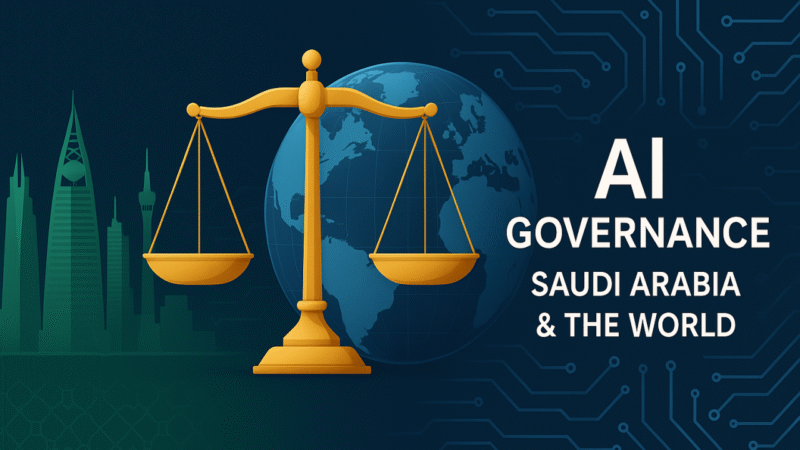
AI Regulation, Governance, and Ethics: Saudi Arabia’s Approach in a Global Context
Introduction: Why AI Governance Matters
Artificial Intelligence (AI) is no longer a futuristic concept—it is embedded in everyday decision-making, from medical diagnoses to financial transactions, hiring processes, and national security systems. Yet with this power comes risk: algorithmic bias, misinformation, privacy intrusions, and potential misuse in ways that could harm individuals and societies.
That is why AI regulation, governance, and ethics are among the most critical policy discussions of our time. Governments and international organizations are asking: How do we encourage innovation while protecting citizens?
Saudi Arabia, under its Vision 2030 framework, has taken proactive steps to position itself as both a regional leader and a global participant in this debate. The Kingdom has begun drafting AI ethics guidelines, hosting international summits, and building institutions like the Saudi Data and Artificial Intelligence Authority ( SDAIA | سدايا ). While many of these efforts remain advisory rather than binding law, they represent an important trajectory toward shaping AI’s role responsibly.
This article examines Saudi Arabia’s initiatives in AI governance and ethics, before comparing them with approaches in the European Union , United States, China, and other global leaders.
Global Foundations of AI Governance
International Principles
Before diving into Saudi Arabia’s case, it’s important to outline the global backdrop. Several key frameworks guide how nations think about AI governance:
- OECD.AI AI Principles (2019): Endorsed by more than 40 countries, including Saudi Arabia, these principles stress fairness, transparency, robustness, and accountability.
- UNESCO Recommendation on the Ethics of AI (2021): The first global standard on AI ethics, focusing on human rights, sustainability, and cultural diversity.
- G7 Code of Conduct & GPAI (Global Partnership on AI): High-level commitments to responsible AI, emphasizing collaboration on safety, innovation, and regulation.
These principles are non-binding, but they heavily influence national strategies. Countries interpret and implement them differently, depending on their governance models, legal systems, and cultural values.
Saudi Arabia’s AI Governance and Ethics
Saudi Vision 2030 and the National AI Strategy
AI is central to Saudi Vision 2030 , which seeks to diversify the economy and build a knowledge-driven society. The National Strategy for Data and AI (NSDAI) was launched in 2020, with the goal of positioning the Kingdom as a top-10 global AI leader by 2030.
To deliver on this ambition, the government established SDAIA | سدايا , tasked with:
- Developing national AI policies and standards
- Overseeing data governance
- Monitoring AI activities
- Promoting responsible adoption across sectors
This centralized authority is unusual compared to more fragmented approaches elsewhere and gives Saudi Arabia an agile mechanism for steering AI development.
AI Ethics Principles (Draft, 2023)
In 2023, SDAIA | سدايا released draft AI Ethics Principles, a framework that outlines high-level values for AI development:
- Fairness and Non-Discrimination
- Privacy and Security
- Human-Centricity
- Reliability and Safety
- Transparency and Explainability
- Accountability
- Social and Environmental Benefit
Crucially, Saudi Arabia’s framework adopts a risk-based model, categorizing AI systems as:
- Minimal/No Risk
- Limited Risk
- High Risk
- Unacceptable Risk
For example, AI that exploits vulnerable populations or poses serious risks to human rights would be banned outright. This mirrors the European Union AI Act, showing Saudi Arabia’s alignment with international best practices.
Generative AI Guidelines (2024)
Recognizing the rise of large language models and deepfakes, Saudi Arabia issued two sets of Generative AI Guidelines in 2024—one for public-sector employees and another for general users.
They provide advice on:
- Preventing misinformation and “hallucinations”
- Using watermarks on AI-generated content
- Filtering training data to avoid harmful outputs
- Raising awareness about deepfake misuse
While not legally binding, these guidelines represent practical governance tools for a rapidly evolving technology.
Soft Law, Not Binding Yet
At present, Saudi Arabia has no dedicated AI law. The Ethics Principles and Generative AI Guidelines are advisory, not enforceable. Compliance is voluntary, though SDAIA | سدايا has the authority to monitor and encourage adoption. Related laws, such as the Personal Data Protection Law, cover adjacent issues like data privacy.
This “guidance today, regulation tomorrow” approach gives Saudi Arabia flexibility while it studies global developments.
Hosting Summits and Driving International Dialogue
Saudi Arabia is also positioning itself as a global hub for AI governance discussions:
- Hosted the Global AI Summit in Riyadh (2020, 2022, 2024), bringing together policymakers, tech leaders, and academics from over 100 countries.
- Organized the UN Islamic World Consultative Session on AI, leading to the Riyadh Charter for AI Ethics in the Islamic World in 2024.
- Established the International Center for AI Research and Ethics( ICAIRE )(a UNESCO -affiliated body) in Riyadh in 2023.
- Co-hosted high-level United Nations AI discussions alongside global leaders.
This dual domestic-international strategy allows Saudi Arabia to shape the AI governance narrative while showcasing its commitment to responsible AI.
Global Comparisons
European Union: The Strictest Model
The European Union is the first jurisdiction to adopt a comprehensive AI law—the EU AI Act. This legislation bans certain practices (like social scoring and exploitative surveillance), heavily regulates high-risk systems, and requires transparency for AI-generated content.
The EU model is precautionary and rights-driven, prioritizing citizen protection even if it slows innovation.
Comparison with Saudi Arabia:
- Both use risk-based classifications.
- EU has enforceable law; Saudi Arabia’s framework is still advisory.
- EU prioritizes fundamental rights; Saudi Arabia emphasizes both global ethics and local cultural/religious values.
United States: Sectoral and Decentralized
The U.S. lacks a single AI law, instead relying on:
- Existing laws (e.g., FTC for consumer protection, DOJ for discrimination).
- Guidance documents like National Institute of Standards and Technology (NIST) ’s AI Risk Management Framework.
- Executive actions, such as the 2023 Executive Order on AI Safety.
This patchwork allows flexibility but risks inconsistency.
Comparison with Saudi Arabia:
- Both lack binding AI-specific laws.
- U.S. governance is decentralized across agencies; Saudi Arabia’s is centralized under SDAIA.
- U.S. emphasizes innovation and civil liberties; Saudi Arabia integrates ethical and cultural dimensions.
China: State-Centric and Content-Controlled
China regulates AI aggressively, especially generative AI. Its 2023 Interim Measures require content to align with socialist values, mandate security assessments, and enforce watermarking of deepfakes.
This ensures government control over AI’s societal impact, but critics see it as prioritizing censorship over innovation.
Comparison with Saudi Arabia:
- Both address risks of deepfakes and misinformation.
- China mandates strict compliance; Saudi Arabia issues voluntary guidelines.
- Saudi Arabia seeks global alignment, while China focuses on domestic ideological control.
United Kingdom, Canada, Japan, and UAE
- UK: Pro-innovation, regulator-led approach with no central AI law.
- Canada: Developing the Artificial Intelligence and Data Act (AIDA).
- Japan: Favors industry self-regulation under Society 5.0.
- UAE: Pragmatic, sector-specific guidelines, with strong investment in AI.
Saudi Arabia sits between these models: more ambitious than the UAE or Japan in global engagement, but not yet as strict as the EU.
Key Comparative Insights
- Regulatory Maturity
- Ethical Convergence
- Governance Structures
- International Engagement
Conclusion: Saudi Arabia’s Role in Shaping AI’s Future
Saudi Arabia has moved quickly from aspiration to action in AI governance. By drafting ethical frameworks, publishing generative AI guidelines, and actively convening international summits, the Kingdom is ensuring it has a seat at the global AI table.
While its guidelines are not yet binding, the foundations are in place for future enforceable regulation that balances innovation with ethics. Importantly, Saudi Arabia’s efforts are not in isolation—they are aligned with OECD, UNESCO, and EU standards, while also introducing cultural and Islamic perspectives.
Globally, AI regulation remains fragmented. The EU leads with binding law, the U.S. prefers flexibility, China enforces strict content rules, and other nations experiment with hybrid approaches. Saudi Arabia’s distinctive contribution is its role as a convener and cultural interpreter, embedding local values into global conversations.
As AI continues to reshape industries and societies, Saudi Arabia’s dual strategy—building a robust domestic framework while driving international dialogue—positions it not just as a participant, but as a shaper of the future of responsible AI.
As Saudi Arabia transitions from ethical guidelines to potential binding AI regulations, how do you think its approach should balance innovation, cultural values, and global alignment—and what lessons can the world learn from this journey?
Contact With Me
Nevine Acotanza
Chief Operating OfficerI am available for freelance work. Connect with me via and call in to my account
Phone: +01234567890 Email: admin@example.com