
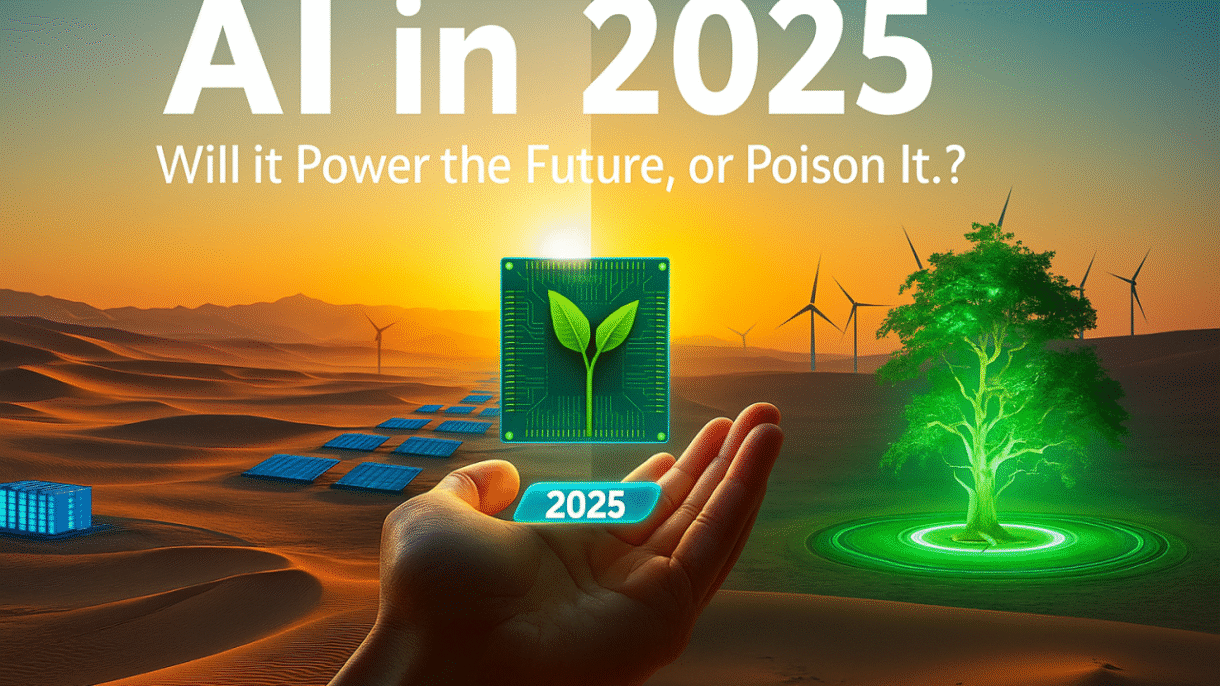

🌅 It was a quiet morning in Riyadh. The sun rose over a city in transformation, where skyscrapers meet desert sands, and bold visions like NEOM and the Red Sea Project are redefining what’s possible.
In a nearby secure data center, an AI model was training — part of a national push toward innovation, automation, and leadership in the digital economy.
But as the algorithms learned, something else was happening silently:
Carbon was being released.
Water was being consumed.
Energy was being drained.
That single AI training job? It emitted as much CO₂ as five average cars do in their entire lifetime. And it used hundreds of thousands of liters of water — a precious resource in any desert climate.
This isn’t science fiction.
This is 2025. And as nations across the Middle East accelerate their AI ambitions — from Saudi Vision 2030 to the UAE’s AI Ministry — we must ask:
Are we building a better future, or just a hotter one?
🔥 The Climate Footprint of Intelligence
We celebrate AI for revolutionizing healthcare, energy, and education.
But we rarely talk about its hidden environmental toll.
Let’s look at the facts:
- 📊 Training a large AI model can emit over 500 metric tons of CO₂ — equivalent to 120 homes’ annual electricity use (source: MIT, 2023).
- 💧 Data centers globally could consume over 450 terawatt-hours of electricity by 2025 — more than the UK’s total annual usage (IEA).
- 💧 They also use massive amounts of water for cooling — Google’s AI operations alone used 15.8 billion liters in 2022, and the trend is rising.
- ⚡ In Saudi Arabia, where cooling demands are high and water is scarce, every liter and kilowatt matters.
And yet, AI compute demand is growing exponentially.
In 2025, we’re not just scaling AI.
We’re supercharging it — without enough guardrails.
🌍 The Global South Is Paying the Price — Even When It’s Leading the Change
We in the Middle East are not just adapting to the future.
We are shaping it.
Saudi Arabia’s Vision 2030, UAE’s AI Strategy, NEOM — these are not just national projects. They are blueprints for a new world.
But here’s the irony:
Countries like Pakistan, Bangladesh, and Sudan — many with minimal AI infrastructure — are already facing the worst impacts of climate change:
- Floods that displace millions.
- Heatwaves that kill.
- Water shortages that threaten survival.
Meanwhile, the AI systems we build — even with the best intentions — add to the global carbon load.
We are creating tools to solve the future…
While unintentionally fueling the crisis.
🤖 But AI Can Be a Force for Healing — If We Choose Wisely
Here’s the good news:
AI isn’t the enemy.
How we build it is.
And in places like Saudi Arabia, we have a unique opportunity to lead differently.
Imagine AI that:
- Optimizes solar farms in the Empty Quarter to power cities at night.
- Predicts sandstorms and protects communities.
- Reduces water waste in agriculture using smart sensors.
- Accelerates green hydrogen research.
This isn’t fantasy.
It’s already beginning.
But to get there, we must build AI that’s not just powerful, but sustainable.
🌱 How We Can Build Green AI — Without Slowing Innovation
The solution isn’t to stop AI.
It’s to redefine progress.
Here’s what we can do — starting today:
✅ 1. Efficiency Over Ego
Use smaller, smarter models (like Mixture-of-Experts or distilled models) that deliver results with less energy. Meta’s Llama 3 proves open and efficient AI is possible.
✅ 2. Power AI with the Sun
Saudi Arabia has some of the highest solar potential in the world. Let’s run our data centers on 100% renewable energy — not just as a goal, but as a standard.
✅ 3. Water-Smart Cooling
Use air-cooled systems, underground data centers, or seawater cooling (via Red Sea projects) to reduce freshwater use.
✅ 4. Measure & Disclose Environmental Impact
Just like financial reports, every AI project should report:
- CO₂ emissions
- Water usage
- Energy source
Transparency builds trust.
✅ 5. Lead Globally, Sustainably
Saudi Arabia and the Gulf can set a new global standard:
AI that’s advanced, ethical, and earth-friendly.
We don’t have to repeat the mistakes of the past.
We can write a new story.
🌍 The Choice Is Ours
We are not just building AI.
We are building the kind of future we want to live in.
One where:
- Technology serves people and the planet.
- Progress doesn’t mean pollution.
- Leadership means responsibility.
Let’s make sure the AI revolution doesn’t come with a climate price tag we can’t afford.
Because the desert remembers every drop of water.
And the planet remembers every ton of carbon.
We have the vision.
We have the resources.
Now, let’s have the wisdom.
🌱 Let’s Build an AI Future That Honors the Earth
Not just for Riyadh.
Not just for Saudi Arabia.
But for every child in Lahore, Jeddah, Jakarta, or Johannesburg who will inherit the world we shape today.
Let’s make AI not just intelligent….
But wise, responsible, and sustainable.
The future isn’t just being coded.
It’s being chosen.
And we’re the ones writing it.
💬 What steps is your organization taking to make AI more sustainable? I’d love to hear your thoughts.