

What Is an AI Agent?
Imagine asking a colleague to “plan your vacation.” You don’t micromanage them—you trust them to research flights, book hotels, and adjust plans if flights get delayed. An AI Agent works the same way.
Unlike tools like ChatGPT (which responds when prompted), an AI Agent:
- Pursues goals autonomously (“Plan a vacation within $3K”).
- Breaks tasks into steps (find flights → compare hotels → build itinerary).
- Self-corrects (if a hotel is full, it finds alternatives).
- Uses tools (browsers, calculators, APIs).
In short: AI Agents don’t just answer—they act.
How Do They Work?
Think of an AI Agent as a self-driving car for tasks:
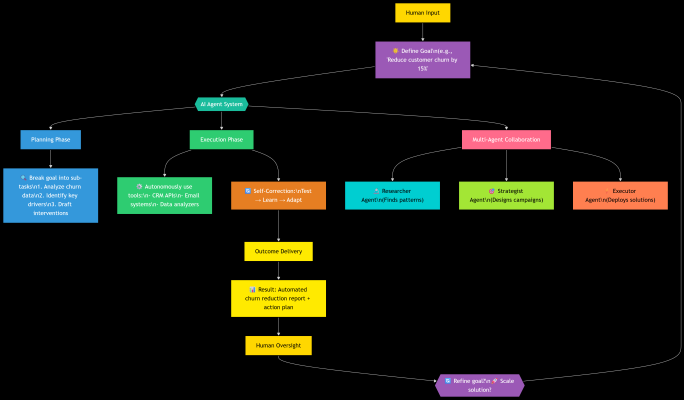
- Goal Input: You define the outcome (“Increase Q3 sales by 10%”).
- Planning: The agent creates a step-by-step plan (analyze data → identify trends → draft campaign).
- Execution: It uses tools (Excel, email, CRM) to execute steps.
- Learning: It learns from feedback (“Campaign A failed? Try Campaign B”).
Real-World Analogy:
- ChatGPT = A brilliant intern who needs constant direction.
- AI Agent = A seasoned project manager who runs the show.
Why Now? The Tipping Point.
Three seismic shifts enabled agents:
- Smarter AI: Models like GPT-4 can reason step-by-step.
- Cheaper Computing: Cloud costs fell 80% in 5 years.
- Tool Integration: Agents now use software (Slack, SAP, GitHub) like humans.
Early Examples You’ve Seen:
- DevOps Agents: Auto-fix bugs in your code.
- Customer Service Agents: Resolve returns/refunds end-to-end.
- Personal Agents: Plan your week, book meetings, and track expenses.
The Future – Where Agents Are Heading?
We’re entering the Age of Agentic Ecosystems, where:
Phase 1: Multi-Agent Teams (2025-2027)
Specialized agents collaborate:
- A “Researcher Agent” analyzes market trends.
- A “Creator Agent” drafts marketing content.
- A “Negotiator Agent” liaises with vendors.
Impact: Cut product launch cycles from months → days.
Phase 2: Human-AI Symbiosis (2028-2030)
- You become a “Conductor”:
- Set high-level goals (“Expand into Southeast Asia by 2030”).
- Agents handle execution (market analysis, regulatory compliance, hiring).
- Ethical AIs: Agents debate trade-offs (“Speed vs. sustainability?”) before acting.
Phase 3: The Self-Improving Ecosystem (2030+)
- Agents build better agents:
- Identify inefficiencies → redesign workflows → deploy upgraded teammates.
- Real-World Impact:
- Healthcare: Agent swarms simulate 100K drug interactions overnight.
- Climate: Agents balance grid demand/renewables across continents.
Why This Changes Everything for You:
- For Professionals:
- Your value shifts from task execution → outcome leadership.
- Upskill in: goal-setting, AI oversight, and ethical guardrails.
- For Businesses:
- Compete on agent orchestration speed (not headcount).
- Win markets by running 24/7 R&D, marketing, and ops cycles.
“The factory of the future will have only two employees: a person and a dog. The person’s job is to feed the dog. The dog’s job is to stop the person from touching the machines.” — With AI Agents, this isn’t a joke. It’s a strategy.
Your First Steps with AI Agents:
- Try a Simple Agent: Identify repetitive, rule-based tasks (data cleanup, report generation).
- Spot Pilot Opportunities: Identify repetitive, rule-based tasks (data cleanup, report generation).
- Join the Conversation: Follow frameworks like Microsoft’s, AutoGen or CrewAI.
AI Agents won’t replace humans—they’ll redefine our potential. The most successful leaders won’t fear autonomy; they’ll harness it to solve problems we once thought impossible.
“We spent 50 years teaching machines to think. Now, we teach them to do.”