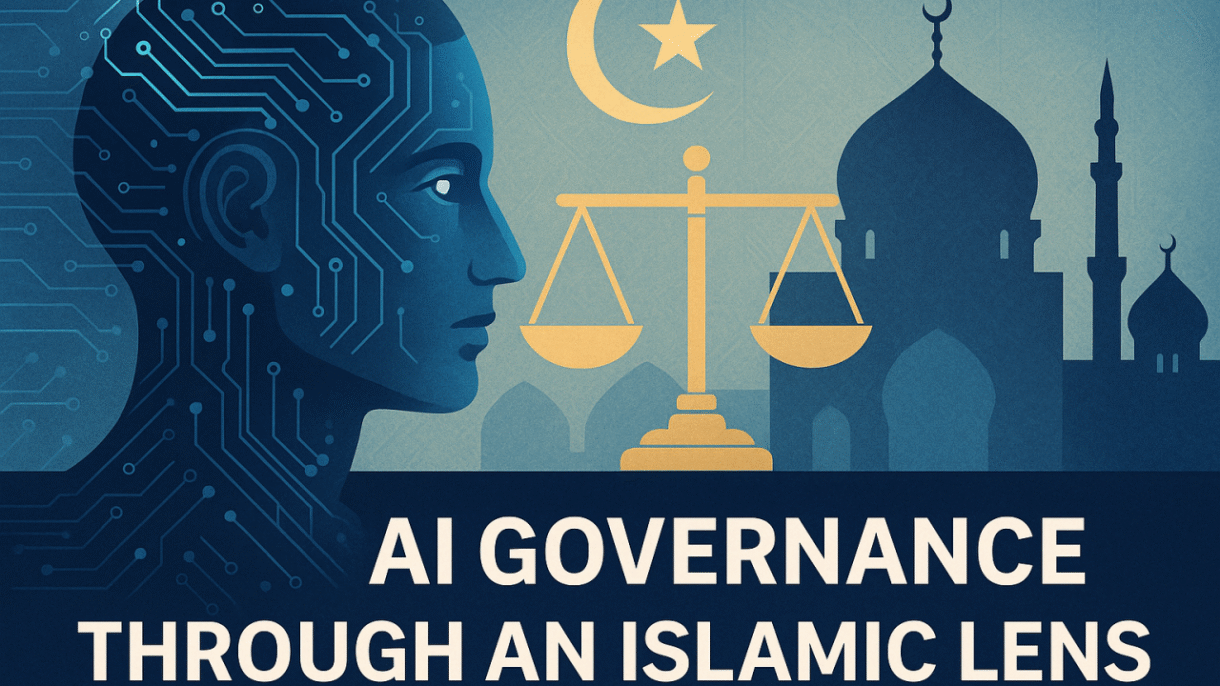

Introduction: Why I’m Writing This
Artificial Intelligence (AI) is no longer a futuristic idea… it’s here, shaping hiring, finance, healthcare, and even what news we consume. I care about this topic because AI isn’t just about data and code… it’s about people, values, and trust.
As someone who works with technology and values-driven leadership, I believe Islamic ethics offers a powerful moral compass for AI governance. And I’m encouraged to see how Saudi Arabia and the wider Islamic world are moving from theory to action with initiatives like the Riyadh Charter.
In this article, I want to connect timeless principles to real-world AI challenges and explain why this matters for governments, businesses, and everyday professionals.
Islamic Ethical Foundations for AI
Maqāṣid al-Sharīʿah: Preserving What Matters Most
The Maqāṣid al-Sharīʿah—preservation of life, intellect, lineage, property, religion, and dignity—offer a surprisingly practical framework for AI:
- Life: AI in healthcare should save lives, not endanger them.
- Intellect: AI in education should fight misinformation, not spread it.
- Lineage & Identity: Prevent AI-driven identity theft or genetic misuse.
- Property: Protect individuals and companies from AI-powered fraud.
- Religion & Dignity: Ensure content generation doesn’t cross ethical or cultural lines.
I believe these objectives are not just philosophical… they are a checklist businesses and policymakers can apply when deciding whether to build or adopt an AI system.
Justice (Adl)
We’ve all seen headlines about biased algorithms in hiring or policing. To me, that’s not just a bug… it’s injustice (ẓulm). Islamic governance calls for fairness reviews and diverse datasets before deployment. I think companies should treat fairness as seriously as security testing.
Trust (Amānah) & Accountability (Mas’ūliyyah)
When an AI denies someone a loan or parole, who’s responsible? I believe leaders can’t hide behind “the algorithm.” In Islam, trust and accountability are sacred. This mindset could push businesses to design governance models where humans remain responsible for AI-driven outcomes.
Human Dignity (Karāmah) & Privacy (Ḥurmah)
Surveillance AI may help in security, but without limits it strips away dignity. The Qur’an affirms: “We have honored the children of Adam” (17:70). For me, this principle is a reminder that privacy isn’t optional—it’s core to dignity, and companies must design with it at the center.
Applying Islamic Ethics to AI Challenges
- Bias in Hiring: Companies risk reputational and legal harm if algorithms discriminate. An Islamic lens insists fairness is non-negotiable.
- Deepfakes in Media: Organizations must prepare for reputational risks from fake videos. I believe policies should combine tech solutions (watermarking) and legal protections.
- Surveillance in Public Safety: Governments can use AI cameras responsibly, but blanket monitoring damages trust. Businesses developing such systems need clear ethical boundaries.
- Healthcare AI: Hospitals using diagnostic AI should demand explainability. For me, this is where ethics and patient safety go hand-in-hand.
What strikes me is that these aren’t just “policy debates”—they’re everyday business risks and leadership decisions.
Islamic World Initiatives in AI Governance
The Riyadh Charter for AI Ethics in the Islamic World
In 2025, 53 Islamic countries adopted the Riyadh Charter led by SDAIA | سدايا and ICESCO . It emphasizes truth, dignity, justice, and privacy.
For policymakers, this provides a shared regional framework. But for businesses and teams, I believe it’s a signal: expect higher expectations for transparency and fairness in products and services across the Islamic world.
Saudi Arabia’s Leadership
Saudi Arabia is leading through:
- SDAIA’s ethics frameworks.
- The International Center for AI Research and Ethics( ICAIRE ) in Riyadh.
- Hosting the Global AI Summit
- Contributions to OECD – OCDE and United Nations AI governance.
What this tells me is that companies operating in or with Saudi Arabia will increasingly need to align with both global and Islamic ethical standards.
OIC and COMSTECH – OIC Standing Committee on Scientific and Technological Cooperation
The OIC’s Tehran Declaration on Ethical AI (2025) is more than a policy… it’s a roadmap for cooperation. For professionals, this signals a future where cross-border projects in the Islamic world will need to comply with ethical guidelines from the start.
International Islamic Fiqh Academy (IIFA)
The IIFA’s work on liability and Shariah questions reminds me that governance isn’t only for regulators—businesses must anticipate how religious and cultural perspectives may influence consumer trust and adoption.
Islamic and Global AI Ethics: Convergences & Distinctives
Convergences
- Fairness & Non-Discrimination: Islamic ʿadl and EU AI Act both demand it.
- Transparency & Accountability: Shared across OECD, UNESCO, and Islamic frameworks.
- Human Dignity: A cornerstone globally and in Islam.
Distinctives from Islamic Ethics
- Spiritual Accountability: Ethical responsibility extends to God, not just regulators.
- Holistic Welfare (Maṣlaḥah): Evaluates broader social good.
- Family & Community: Protection of family values alongside individual rights.
- Red Lines: Clear prohibitions against immoral AI use.
For me, the biggest insight is this: Islamic ethics raises questions others don’t always ask… not just “Can we build this?” but “Should we, and who truly benefits?”
Conclusion: Why This Matters to Me
AI governance affects us all… whether we’re professionals adopting AI tools, businesses building AI products, or policymakers setting standards. What excites me is how Islamic principles offer timeless guidance to shape this technology responsibly.
That’s why I believe initiatives like the Riyadh Charter matter: they show how values—justice, dignity, and trust… can be turned into action. For businesses, it means higher accountability; for policymakers, stronger frameworks; and for communities, greater protection.
As Dr. Salim M. Al-Malik, Director-General of ICESCO, said, the Riyadh Charter acts as “a moral compass anchored in Islamic values, filling the gaps left by international charters that often overlook cultural and spiritual dimensions.” His vision reflects how Islamic institutions can lead in shaping AI ethics at a global level.
At the same time, Dr. Mona Hamdy reminds us that an Islamic perspective on AI must always prioritize “justice before efficiency… character before code.” She also speaks of a potential “Platinum Islamic Age”—a time when science, ethics, and faith advance together.
I believe that future is possible, and it starts with embedding these values into every AI decision we make.
💬 Let’s Discuss
👉 How can Islamic principles—justice, dignity, and trust—help shape a global AI governance framework that truly serves all of humanity?